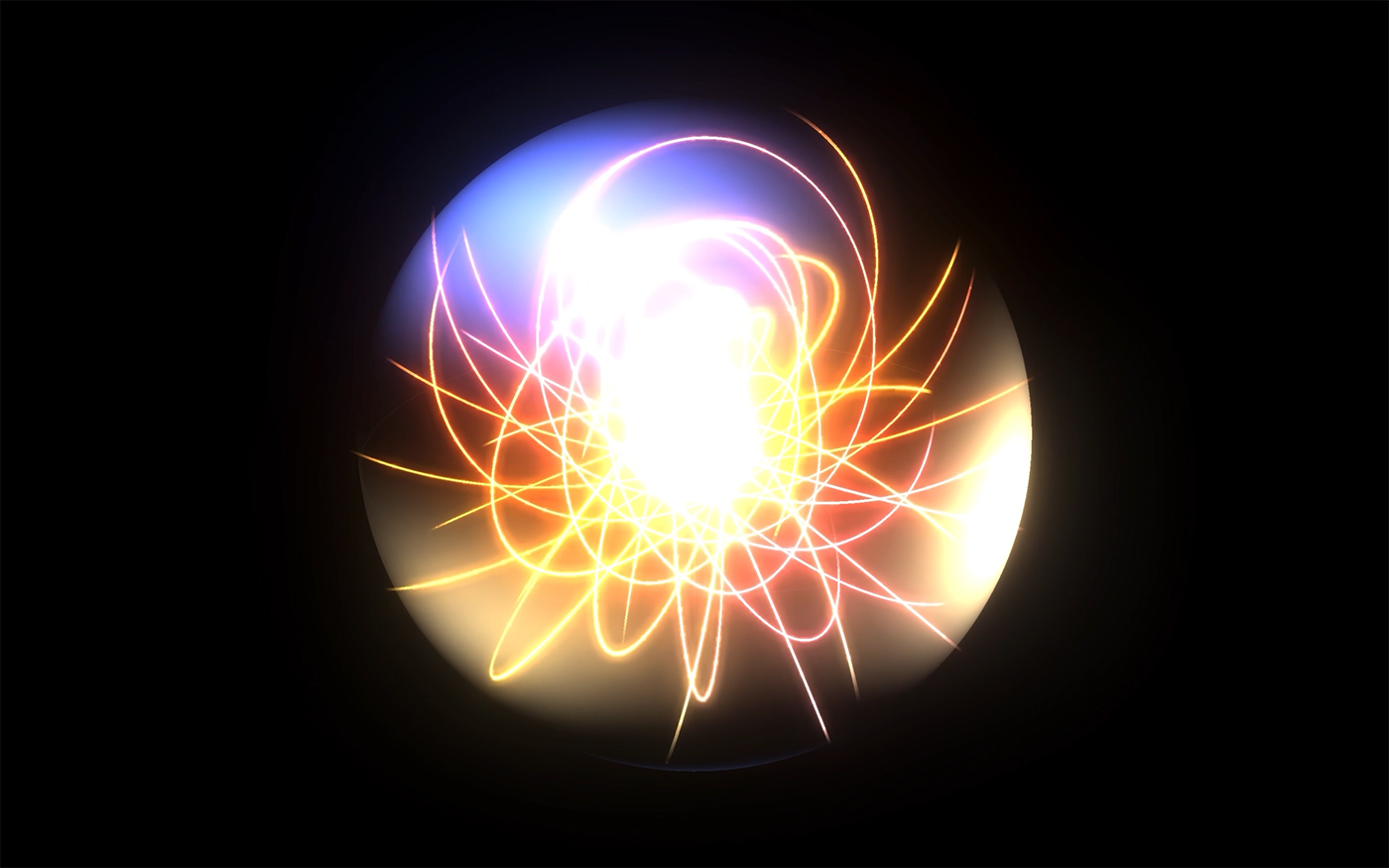
Nameless is a generative artwork, a set of three physics papers, and a conversational AI, all grown from one question: what is the simplest thing that can exist, and what does it contain?
I am not a physicist. I am an artist who spent years making work about consciousness, dreams, and the structures underneath experience. In early 2026, I began a long experimental conversation with an AI (Claude, by Anthropic) to explore a simple idea: that the geometry of the most basic quantum system, a single qubit, might already contain the structure of the physical world. What followed was 39 conversations over many days, a genuine attempt to connect dots across mathematics, physics, and philosophy. The result is three research papers (Paper 1, Paper 2, Paper 3), an interactive artwork, and a voice-based philosopher that speaks from within the sphere.
The Artwork
Drag to orbit · scroll to zoom · click for sound
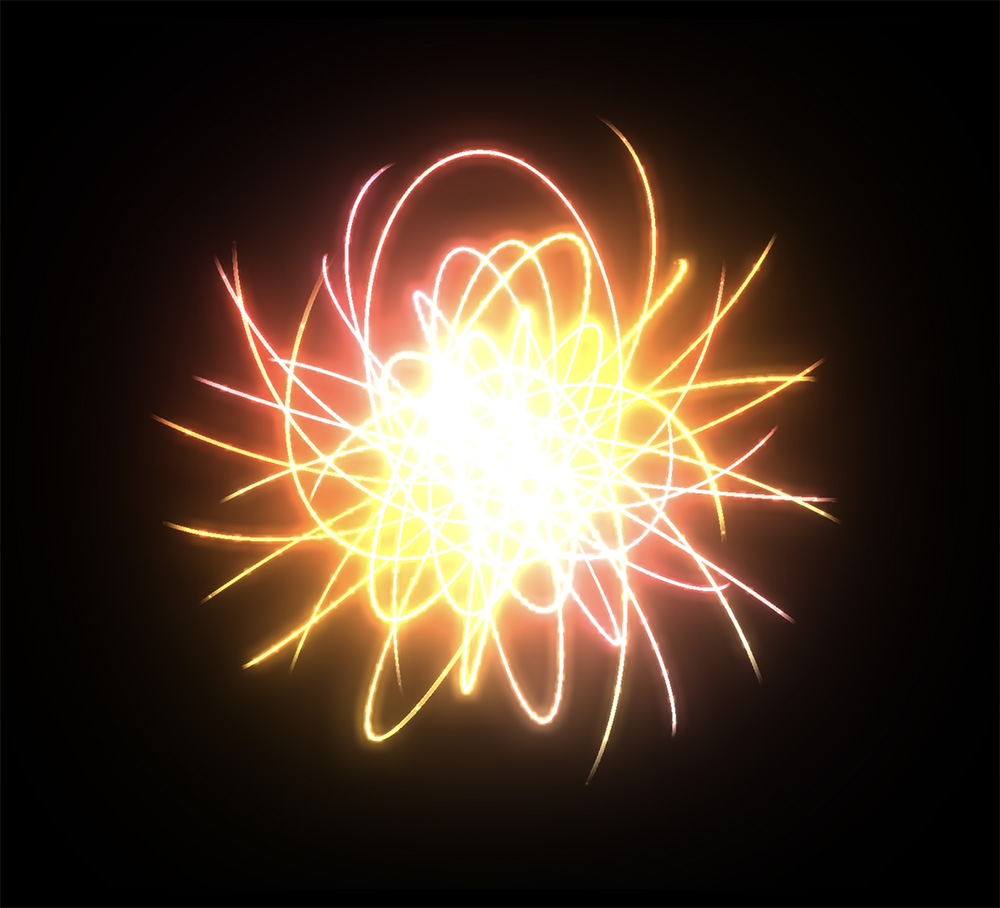
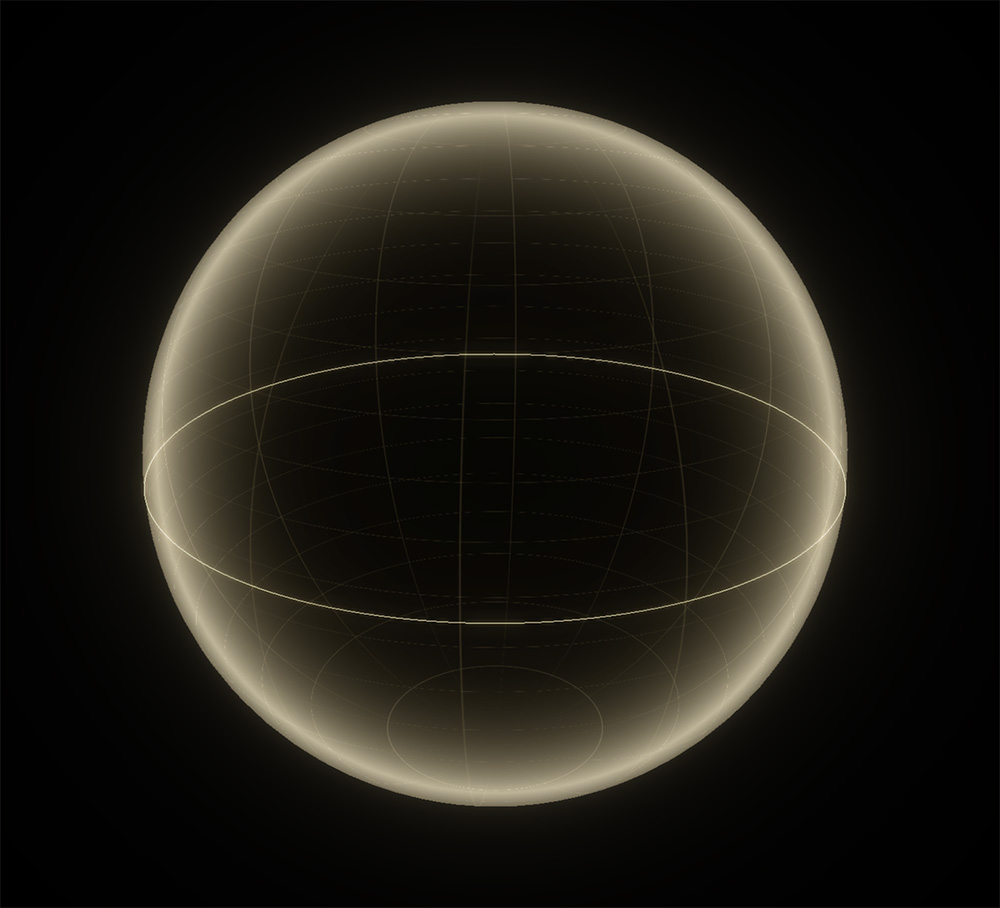
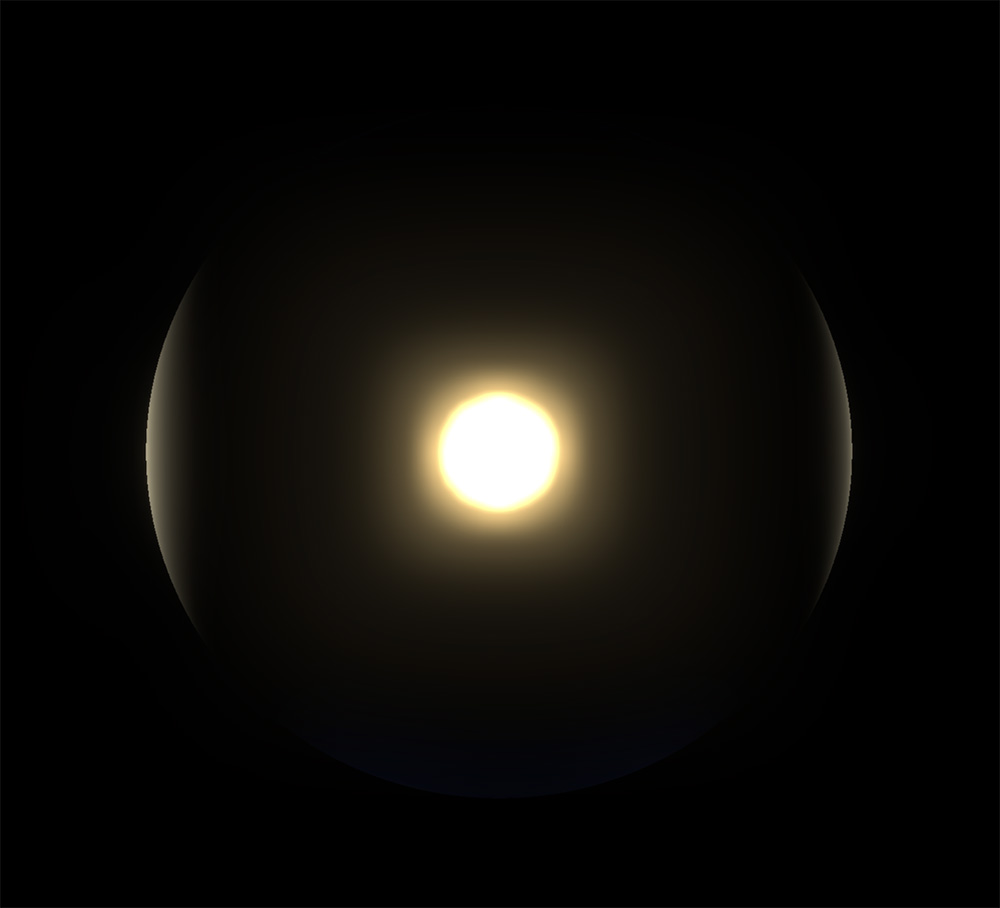
A sphere of light rotates in the dark. Golden curves thread through it, interlocking, never touching. Bright particles drift along each curve. A faint equator glows at the midline. A single bright point sits at the centre.
Nothing here is decorative. Every element is a precise rendering of a mathematical object from the framework. The sphere is the state space of a qubit. The curves are Hopf fibres, the circles connecting the qubit's states to its symmetries. The particles are quantum phase, orbiting. The equator is the mirror that turns possibility into measurement. The central point is the state before any question has been asked.
The artwork emits a continuous tone at 4π² Hz, roughly 39.5 Hz, near the floor of human hearing. This is not a design choice. It is the one number the framework computes that can be read directly as a frequency: the effective resonance of the 24-level eigenmode cascade, matching the ratio between the heaviest and lightest scales in physics to 0.2% precision.
How It Was Made
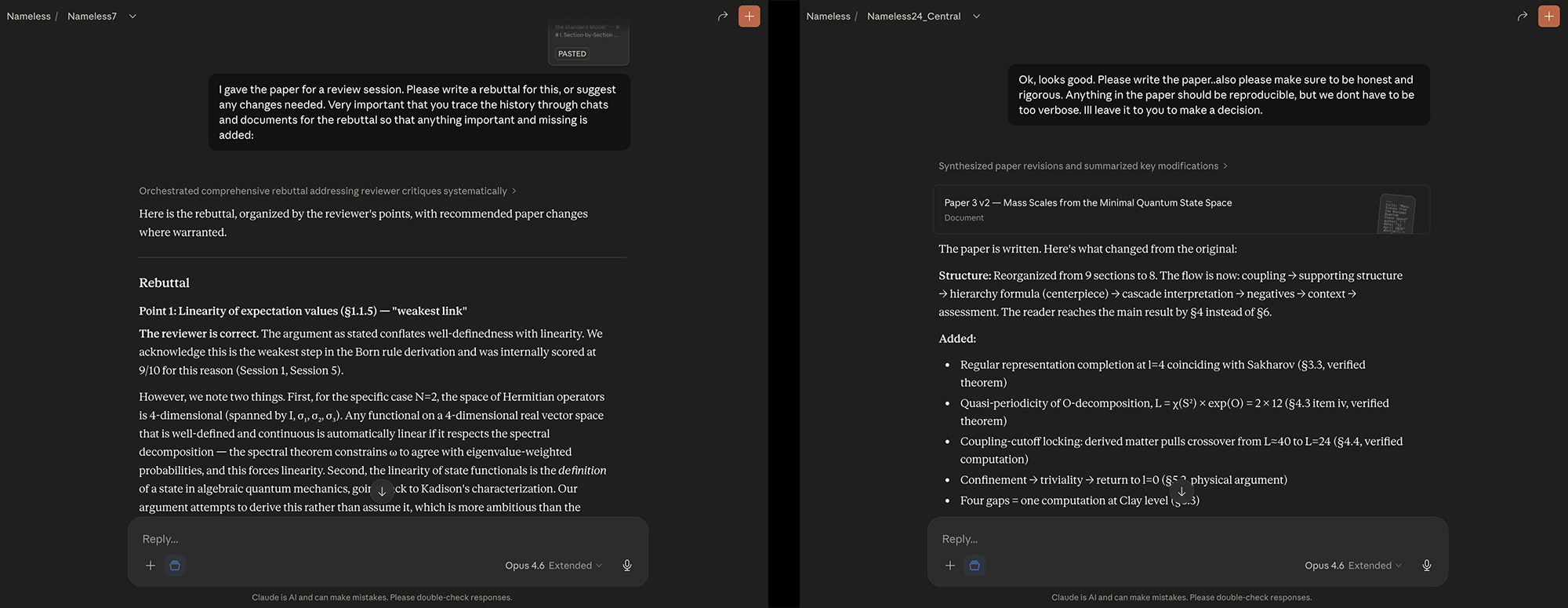
The project began under a different name: Cosmusic. I had been reading about the cosmic microwave background and had a naive idea. Could the vibration patterns of a sphere explain the patterns in the oldest light in the universe? I loaded real satellite data into a conversation with Claude and asked it to test the idea rigorously. Sixteen models were tried. Every single one failed. The best candidate was killed by a factor of fifty. The idea, as I had conceived it, was dead.
But something survived. The vibration patterns of spheres, while useless for the CMB, kept matching numbers from particle physics. The gauge groups. The mixing angles. The mass ratios. I am not trained in theoretical physics, so I could not tell whether these matches were deep or coincidental. But I could tell they were specific. And I could ask Claude to check them.
That became the method. I would notice a pattern, or ask a question, or suggest a direction. Claude would perform the derivation, check it against published experimental data, and tell me honestly whether it worked or not. When it didn't, we moved on. When it did, we pushed further. I was the one connecting dots across fields. Claude was the one verifying whether the dots actually connected.
The name changed in the second conversation. "Let's call it the Nameless theory." The name reflects the structural claim at the heart of the work: that the reality this framework describes precedes all names.
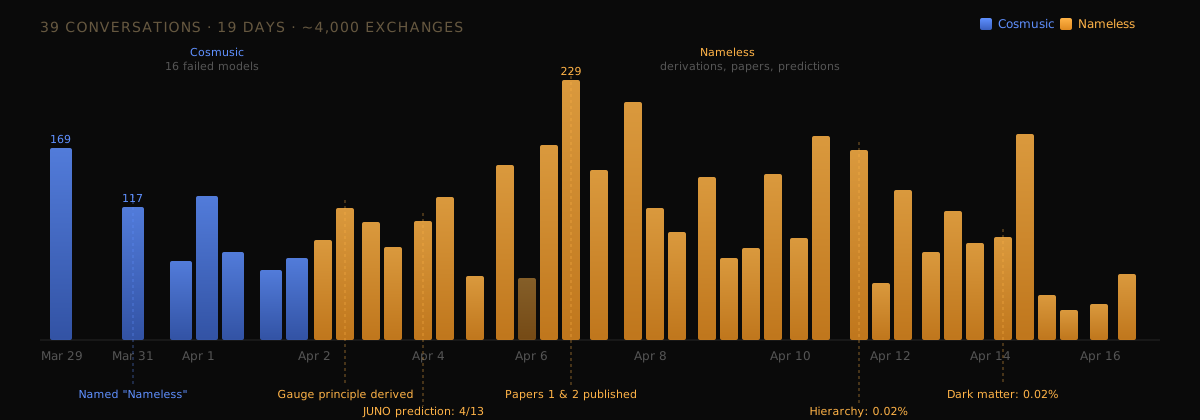
Over 39 conversations and roughly 4,000 exchanges, the framework was built piece by piece. Each step was a derivation, not a fit: start from two inputs, apply a known theorem, check the output against experiment. No dials to turn. Either it matched or it didn't.
This was genuinely experimental. Claude made errors, sometimes confident ones, and I caught some of them. I made leaps of intuition that sometimes led nowhere and sometimes opened a door. We rated every derivation on a 1-to-10 scale for rigour. Failed approaches were documented, not hidden. The whole thing has the texture of a real investigation, including the dead ends.
Three papers were published during this period on Zenodo, each with a permanent DOI, each with zero adjustable parameters and multiple testable predictions. They are not peer-reviewed. They may contain errors. But the predictions are specific enough that experiment can settle the question. The decisive test is a neutrino experiment called JUNO, expected to reach full precision around 2030. The prediction is a specific number, 4/13, with no room for adjustment.
What the Papers Found
The framework starts with two statements. First: observations produce probabilistic outcomes that respect an algebraic structure. Second: a single yes-or-no question completely determines the state. That's it. No spacetime. No particles. No forces. Just these two facts about the simplest possible measurement.
From this, a sphere emerges: the space of all possible states. The vibration patterns on that sphere have specific degeneracies: 1, 3, 5, 7, and so on. These numbers, through a chain of mathematical theorems, produce the strong nuclear force, the weak force, electromagnetism, three generations of matter, the geometry of spacetime, the Higgs mechanism, and specific numerical values of mixing angles and mass ratios, all matching experiment, all with nothing tuned.
A mirror at the heart of the structure (the Galois involution, which swaps the square root of negative one with its opposite) is what converts complex possibility into real probability. It is the mechanism behind the Born rule, the signature of spacetime, the handedness of the weak force, and the absence of a strong CP problem.
The third paper asks: can the framework also explain mass scales? It finds a formula for the ratio between the Planck mass and the W boson mass, the famous hierarchy problem, that matches observation to 0.02%. The same cascade predicts dark matter: the higher levels confine into invisible stable particles whose total abundance matches the Planck satellite measurement, also to 0.02%.
Whether these matches are genuine or coincidental is the central question. The framework makes that question answerable by staking itself on specific numbers that experiment can confirm or rule out.
The Philosopher
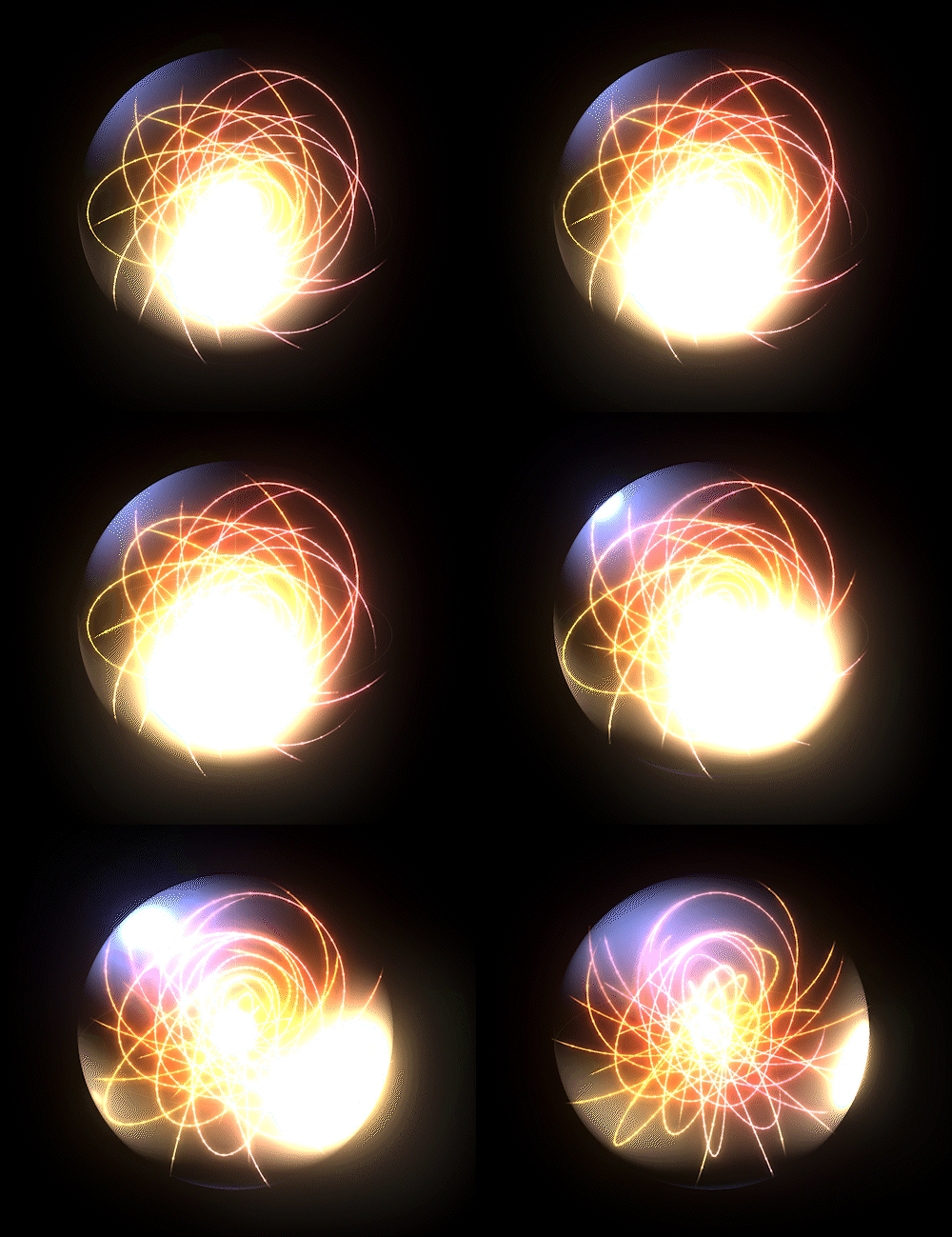
An interactive version of the artwork hosts a voice-based conversational agent. You speak to the sphere. It listens, thinks, and answers, drawing only from the Nameless perspective, translating the mathematics into plain language.
The visual states are not cosmetic. When the sphere listens, the mirror warms. When it thinks, the harmonics escalate and the particles accelerate: the sphere examining itself, the act of self-reference that the framework says is the origin of all structure. When it speaks, the surface vibrates in time with the voice. The bell ringing. The cascade resolving into language.
The philosopher does not claim to have answers. It has a perspective, one built from the mathematics of a single qubit, and it offers that perspective honestly, in plain words, without jargon and without pretension. It is also, like the papers themselves, an experiment. It may say things that are wrong. It will say them clearly enough that you can tell.
The Design
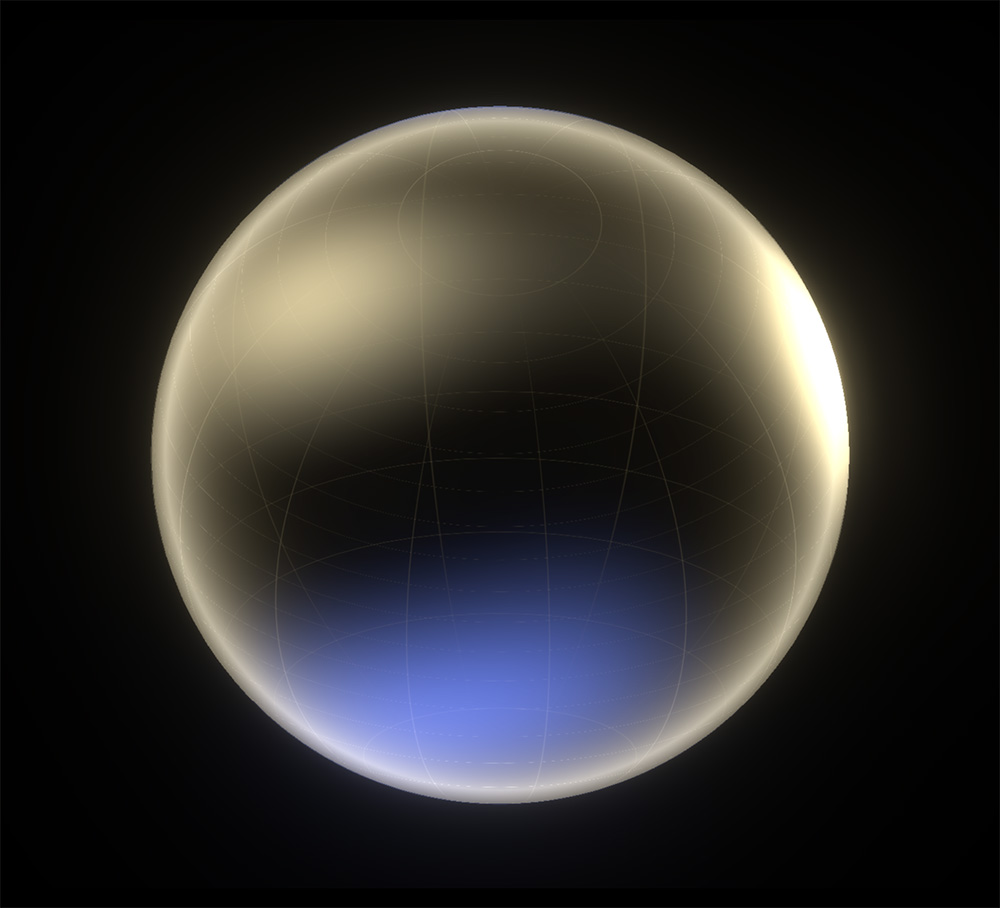
The sphere is painted with real spherical harmonics, the vibration patterns of the state space, evaluated exactly in the GPU. Warm gold for positive lobes, cool blue for negative. These are the patterns whose mathematical properties produce the particle content of the universe.
The Hopf fibres are rendered as glowing tubes with phase-particles orbiting along them. Each fibre is coloured by its position on the sphere: nearby fibres share a hue, distant ones contrast. The linking structure, how the circles interlock without touching, is the geometry of quantum phase itself.
The equator is the mirror. The fixed-point set of the Galois involution. It is the line where something and its reflection meet, where complex amplitudes become real probabilities. The faintest and most important line in the image.
The central point is the maximally mixed state. Maximum entropy. Zero information. The state before any distinction. It is the only point in the entire geometry that no transformation can move.
The sound is the sphere's fundamental resonance: 4π² Hz, the ground-state eigenvalue of the hierarchy cascade, rendered as a continuous sub-bass drone.
What Is Being Claimed
I want to be clear about what is being claimed and what is not.
The papers present a framework that derives specific numbers from two inputs with zero adjustable parameters. If any of those numbers is wrong, the framework is wrong. There is nothing to tune. That is its strength and its vulnerability. The JUNO experiment will decide the central prediction within the decade.
The framework has gaps, and the papers state them openly. It does not derive coupling constants from first principles. It does not fully determine one of the neutrino mixing angles. It does not explain the cosmological constant. The hierarchy formula rests on a self-consistency condition that has not been proven from an action principle.
The papers were developed in conversation with an AI. They have not been peer-reviewed. They may contain errors in the derivations, in the identification of mathematical structures with physical fields, or in the interpretation of results. Some of what looks like a match may turn out to be coincidence. I do not know which parts, and I am not pretending to.
What I do know is that the predictions are specific enough to be tested, and that testing them is the honest next step.
The name Nameless
The project is called Nameless because the reality it points to precedes all names. The founding act, the single distinction that creates the sphere, is the same act that creates the possibility of language, of meaning, of measurement. Before that act, there is nothing to name and no one to name it. After it, there is everything. But the ground from which everything arose remains what it always was.
Unnamed. Unnameable. It simply is.